
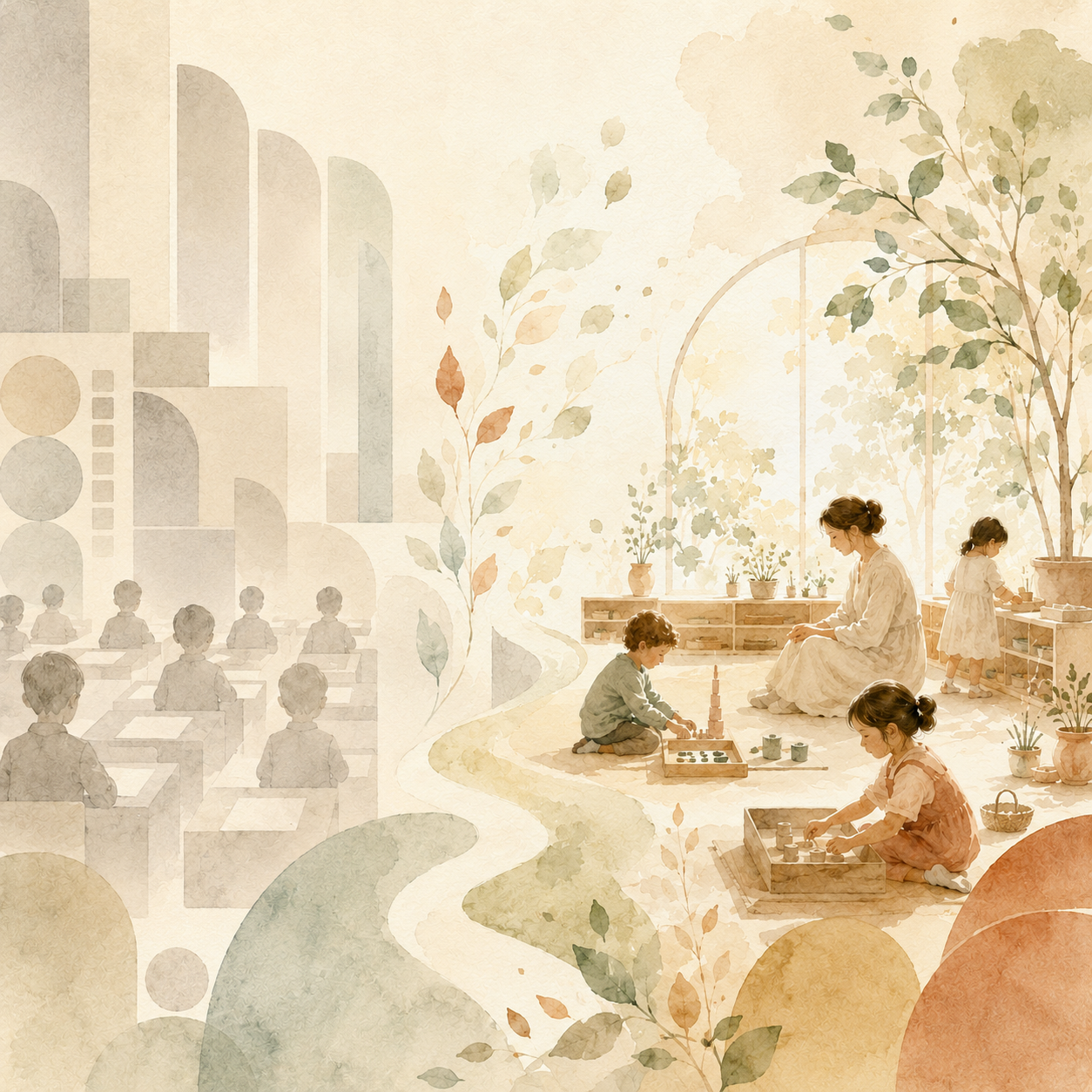
Discipline or Obedience? What Are We Really Teaching Our Children?
There is a familiar picture of the “disciplined” child.
They sit quietly. They follow directions the first time. They complete what is assigned without protest. They wait for permission. They receive a good grade, a sticker, a smile, or approving words from the adult.
They are easy to teach.
Easy to manage.
Easy to praise.
But I have been wondering whether what we call discipline is often something else entirely.
My unpopular opinion is that many schools do not truly teach discipline. They teach obedience.
This is not a judgment of teachers, many of whom are working with extraordinary care inside systems that leave little room for observation, flexibility, or individual pacing. Educators may be responsible for dozens of children while navigating rigid schedules, testing demands, curriculum requirements, behavioral systems, and limited resources.
The pattern I am questioning is larger than any individual teacher.
It is a system that often defines success through a child’s ability to fit the existing mold rather than through the environment’s ability to respond to the child.
When fitting in becomes the measure of success
Every child arrives with a unique constellation of characteristics.
One needs movement to think. Another needs silence.
One learns by touching and constructing. Another learns through conversation, story, or careful observation.
One responds immediately. Another needs time to process.
One is highly sensitive to noise, texture, transitions, or social pressure. Another is energized by them.
Children also differ in culture, temperament, developmental timing, prior experiences, interests, communication styles, abilities, and nervous-system needs. Learning science recognizes that development and learning are shaped by both individual characteristics and the environments and opportunities available to the learner.
Yet many educational environments remain organized around uniformity.
Children of the same age are expected to learn the same material, in the same way, within the same period of time. They are often asked to sit for similar lengths of time, demonstrate understanding through similar formats, and progress according to an externally determined sequence.
The child who adapts successfully is praised.
The child who cannot may be described as unmotivated, disruptive, inattentive, careless, immature, or behind.
Sometimes children do need additional guidance, intervention, or support. But we must also be willing to ask a more uncomfortable question:
Is the child struggling to learn, or is the child struggling to learn under the conditions we have created?
Universal Design for Learning offers a helpful shift. Rather than locating the problem entirely within the learner, it asks educators to examine and redesign the environment so that learner variability is expected and barriers are reduced. Its goal is not to remove challenge, but to create meaningful, rigorous opportunities through which more learners can participate and develop agency.
The child should not always be the one required to bend.
Sometimes the environment must bend, too.
Obedience and discipline are not the same
Obedience is the act of following an instruction or submitting to an external authority.
Discipline, in its deeper developmental sense, is the growing capacity to regulate one’s behavior, manage impulses, persevere through difficulty, consider the needs of others, and act in accordance with internalized values and responsibilities.
A child can be obedient without being self-disciplined.
They may remain quiet because they fear punishment. Complete an assignment to earn a prize. Apologize because an adult demanded it. Share because someone is watching.
The behavior may look appropriate, but the decision is still being governed from outside the child.
A self-disciplined child is gradually developing something more enduring. They begin to pause before acting, tolerate frustration, care for their surroundings, repair harm, complete meaningful responsibilities, and make thoughtful choices even when an adult is not directing every step.
Of course, this capacity does not appear overnight. It develops slowly through relationships, repeated experiences, appropriate expectations, opportunities to practice, and the maturation of executive functions.
Children borrow regulation from adults before they can regulate themselves.
The question is not whether adults should guide children. We absolutely should.
The question is whether our guidance is helping children develop an inner compass, or simply teaching them to wait for our commands.
What is extrinsic discipline?
“Extrinsic discipline” is not a formal diagnostic term. I am using it here to describe behavior that is regulated primarily by external consequences and approval.
Examples include:
- Working to receive a sticker, prize, grade, or treat
- Behaving to avoid punishment, public correction, or loss of privileges
- Completing work mainly to please the teacher or parent
- Following rules only when an authority figure is present
- Seeking constant reassurance that one’s performance is “good”
Extrinsic motivation is not automatically harmful. Not every activity will be naturally interesting, and children sometimes need an external structure to begin an unfamiliar, difficult, or necessary task.
A toddler may need an adult beside them to complete a routine. A student may need a checklist while learning to organize a long project. A child may initially practice a skill because the adult has established it as a responsibility.
External support can provide clarity, immediate feedback, consistency, and safety. It can also help a child experience enough early success to begin feeling competent.
The benefits of extrinsic discipline
Extrinsic systems can:
- Establish immediate boundaries in unsafe situations
- Clarify expectations that a child does not yet understand
- Support the early stages of habit formation
- Make abstract expectations more concrete
- Help adults manage groups when time and resources are limited
- Provide temporary scaffolding for skills still under development
The risks of overreliance
When external control becomes the primary motivational system, it can create several difficulties.
A child may ask, “What will I get?” rather than “Why does this matter?”
They may behave appropriately only when monitored. They may choose easier work to protect a grade or reputation. They may hide mistakes, avoid unfamiliar challenges, or become highly dependent on praise.
They may also begin to understand goodness as something measured by adult approval rather than by the effects of their choices on themselves and their community.
The research on rewards is nuanced. Rewards do not destroy motivation in every circumstance, and their effects vary according to the task, the child, the type of reward, and how controlling or informational it feels. Still, Self-Determination Theory warns that external regulation can undermine autonomy when children experience rewards, threats, or evaluations as attempts to control their behavior.
The issue is not the occasional certificate, celebration, or joyful acknowledgment.
The issue is building an entire childhood around the message:
Perform for me, and then I will tell you that you are worthy.
What is intrinsic discipline?
“Intrinsic discipline” is a parent-friendly way to describe self-discipline arising from increasingly internalized values, self-regulation, and autonomous motivation.
The child is not always acting because the task is enjoyable. Cleaning a spill or persisting through a challenging lesson may not be pleasurable in the moment.
Instead, the child increasingly understands and owns the reason:
“I clean the spill because I care for our environment.”
“I wait because other people deserve a turn.”
“I continue practicing because this skill matters to me.”
“I tell the truth because honesty is part of the person I want to become.”
Psychologists Richard Ryan and Edward Deci describe three fundamental psychological needs that support healthy motivation:
Autonomy: I experience some ownership and meaningful choice.
Competence: I feel capable of growing and succeeding.
Relatedness: I feel respected, connected, and securely included.
Autonomy does not mean children control every decision. It means they experience themselves as participants rather than objects being managed.
Competence does not mean every task is easy. It means the challenge is attainable and the child receives useful support and feedback.
Relatedness does not mean avoiding accountability. It means the relationship remains secure even while limits are held.
Research on student motivation has found that autonomy-supportive teaching is associated with stronger need satisfaction and more self-determined motivation.
The benefits of intrinsic discipline
As self-discipline develops, children may be more likely to:
- Continue when immediate rewards disappear
- Take responsibility for their choices
- Make decisions when adults are absent
- Recover from mistakes without seeing themselves as failures
- Experience greater ownership of their learning
- Choose appropriate challenges rather than only safe successes
- Connect their behavior to personal and communal values
- Develop a more stable sense of identity and purpose
Its challenges and limitations
Intrinsic discipline is slower to cultivate.
It does not always produce immediate compliance. Children need opportunities to question, practice, fail, reflect, repair, and try again. That process can look less orderly than a reward chart or a threat.
Children also cannot be expected to find every responsibility intrinsically enjoyable. Mature self-discipline includes doing some things because we have internalized their importance, not because we delight in every step.
A child’s developmental capacity matters as well. A three-year-old cannot consistently regulate emotions or delay impulses like a ten-year-old. Neurodivergence, trauma, stress, sleep, sensory needs, disability, language development, and emotional safety can all affect regulation.
We should never interpret a child’s difficulty with self-control as a moral defect.
Intrinsic discipline does not mean withdrawing support and waiting for children to manage themselves. It means offering the right support while gradually transferring appropriate responsibility.
Montessori’s vision of discipline
Montessori education presents discipline not as stillness imposed by the adult, but as an inner organization that develops through meaningful activity.
The Montessori classroom is carefully prepared so that children can move, choose purposeful work, repeat activities, correct errors, care for their surroundings, and participate in a functioning community.
This freedom is always held within limits.
A child may choose their work, but may not misuse the material.
They may move through the room, but must protect the concentration of others.
They may repeat an activity, but must return it ready for the next person.
They may exercise independence, but that independence exists alongside responsibility.
Association Montessori Internationale describes freedom within limits as a balance that helps children manage impulses and make thoughtful choices. It also emphasizes that the adult’s role is not to control the child, but to connect the child to a purposeful environment and provide a safe framework for development.
This is an important distinction.
Montessori freedom is not permissiveness.
Montessori discipline is not obedience training.
The child develops control through using their will, not through having their will repeatedly broken.
Practical Life activities are particularly powerful in this process. Pouring water, carrying a tray, preparing food, washing a table, fastening clothing, sweeping, and arranging flowers may appear simple. In reality, they require coordinated movement, sequencing, concentration, inhibition, care, and completion.
The child experiences a full cycle of purposeful activity:
I noticed a need.
I chose to act.
I prepared myself.
I completed the work.
I observed the result.
I restored the environment.
Through repetition, discipline becomes embodied rather than merely explained.
Research comparing a faithfully implemented Montessori program with other school environments has found advantages in areas including executive function, social cognition, positive peer interaction, academic skills, creativity, and sense of school community. The researchers also emphasized that Montessori schools vary and that further replication is necessary, an important reminder not to treat any educational method as a guarantee.
Praise, approval, and the mold of the “good child”
Praise can feel like the gentler alternative to punishment, but praise can also become a subtle method of control.
“Good girl.”
“You are so smart.”
“You are the best student.”
“I love how quiet you are.”
These phrases may be offered with affection. Yet repeated evaluative praise can teach children to view themselves through the adult’s eyes.
Instead of asking, “What did I learn?” the child may ask, “Did I impress you?”
Instead of experimenting freely, they may protect the identity of being smart.
Instead of offering authentic kindness, they may perform the version of goodness that receives recognition.
Mueller and Dweck’s research found that fifth graders praised for intelligence were more likely to orient toward performance goals and showed less persistence and enjoyment after failure than children praised for effort. Those praised for effort were more inclined toward mastery and improvement.
This does not mean children should grow up without encouragement.
Children need delight. They need warmth. They need adults who notice them and celebrate alongside them.
The shift is from judging the child to describing the process.
Instead of:
“You are so clever.”
Try:
“You kept adjusting the pieces until they fit.”
Instead of:
“Good sharing.”
Try:
“You noticed she was waiting and made room for her.”
Instead of:
“What a beautiful picture!”
Try:
“Tell me about the colors you chose.”
Instead of immediately declaring the work good or bad, invite reflection:
“What was the most difficult part?”
“What did you discover?”
“Is there anything you would change?”
“How did you know you were finished?”
The purpose is not to use better wording to manipulate children into compliance. It is to help them develop awareness of their own strategies, decisions, progress, and values.
We cannot manufacture self-motivation
Adults often ask, “How do I motivate my child?”
The question assumes motivation is something we insert into children.
But children arrive with powerful developmental drives. They want to move, communicate, imitate, contribute, connect, explore, repeat, understand, and become capable.
Our task is often not to manufacture motivation, but to protect it from being buried beneath excessive control, interruption, comparison, pressure, and fear of failure.
Self-motivation grows when children regularly experience four things.
Meaningful autonomy
Offer choices that are real but developmentally appropriate.
“You may begin with reading or mathematics.”
“Would you like to carry the basket or the tray?”
“You need to complete the assignment. Which part would you like to tackle first?”
The adult continues to hold the boundary, but the child has some authorship within it.
Developing competence
Children need work that sits between boredom and overwhelm.
Break complex tasks into visible steps. Demonstrate slowly. Allow repetition. Make tools accessible. Provide enough assistance for success without taking over the work.
The message should be:
“This is challenging, and you are capable of growing into it.”
Secure connection
Children are more able to explore and take healthy risks when belonging is not conditional on achievement.
Correct behavior without withdrawing love or dignity. Hold limits calmly. Repair after conflict. Let children know that mistakes affect choices and consequences, but do not erase their place in the family or classroom.
Purpose and contribution
Children flourish when they know their presence matters.
Invite them to prepare food, care for a plant, help a younger child, arrange materials, solve a genuine problem, or participate in family and classroom decisions.
Contribution tells the child:
“You are not merely being prepared for life. You are already part of life.”
Creating an environment where each child can blossom
A child-centered environment is not one in which children receive everything they want.
It is one in which we respect development enough to ask what conditions allow this particular child to grow.
That may include:
A predictable rhythm without excessive rigidity.
Materials children can reach and manage independently.
Movement woven into learning.
Periods of uninterrupted concentration.
Multiple ways to explore and express understanding.
Quiet spaces for children who become overwhelmed.
Clear limits stated respectfully and consistently.
Meaningful responsibilities rather than artificial rewards.
Opportunities to follow interests while still developing essential skills.
Time for observation before adult intervention.
Feedback that is specific, useful, and nonshaming.
Consequences connected to the action whenever possible.
Adults who are willing to examine the environment before blaming the child.
The National Academies emphasizes that learning is shaped by the interaction of individual factors, interests, motivations, social contexts, environments, and available opportunities. CAST’s Universal Design for Learning similarly encourages educators to design for variability rather than treating difference as a deficit.
This is where Montessori principles and modern learning science meet beautifully.
Prepare the environment.
Observe the learner.
Remove unnecessary obstacles.
Offer purposeful choices.
Protect concentration.
Maintain clear limits.
Trust development without becoming passive.
The child beneath the behavior
Sometimes the compliant child is not deeply disciplined.
They may be anxious.
They may be masking.
They may be afraid to disappoint.
They may have learned that belonging depends on performance.
And sometimes the child who resists is not undisciplined.
They may be protecting a need for autonomy.
They may be overwhelmed by sensory input.
They may not understand the purpose.
The task may be far above or below their current level.
They may need movement, connection, rest, clarity, or a different path into the learning.
Behavior still requires guidance. Harmful actions still need limits. Communities cannot function if everyone simply does whatever feels good in the moment.
But behavior is also communication.
Our responsibility is to respond to both the action and the need beneath it.
What are we preparing children for?
If the purpose of childhood is to produce quiet students who complete assigned work, then obedience may appear sufficient.
But if we are preparing children to become adults who can think critically, create, collaborate, make ethical decisions, regulate themselves, challenge injustice, care for others, and contribute with purpose, obedience is not enough.
A child who always waits to be told what to do may become an adult who struggles to trust their own judgment.
A child who is rewarded only for being correct may become afraid of innovation.
A child who succeeds by fitting the mold may never discover the shape of their own gifts.
Education should provide children with knowledge and skills. It should also help them develop the capacity to direct those skills wisely.
Our goal is not to raise children who reject every limit.
It is to raise children who understand why limits exist, who can question them thoughtfully, who can accept responsibility, and who can increasingly guide themselves.
The deepest discipline does not announce itself through perfect stillness.
It can be seen in the child who returns to a difficult problem.
The child who repairs what they damaged.
The child who makes space for someone else.
The child who chooses integrity without applause.
The child who knows when to cooperate and when to ask a brave question.
The child who is not simply performing goodness, but slowly making it part of who they are.
Let us give children roots strong enough to hold responsibility and room wide enough to become themselves.
They were never meant to be pressed into identical molds.
They were meant to grow, each in their own rhythm and direction, toward the light. 🌿
Research foundation
This essay draws primarily on Self-Determination Theory and its account of autonomy, competence, relatedness, internalization, and motivation; research on autonomy-supportive teaching; studies of praise and achievement motivation; Montessori research and AMI guidance on freedom within limits; the National Academies’ synthesis of learning science; and CAST’s Universal Design for Learning framework.
Leave a comment