
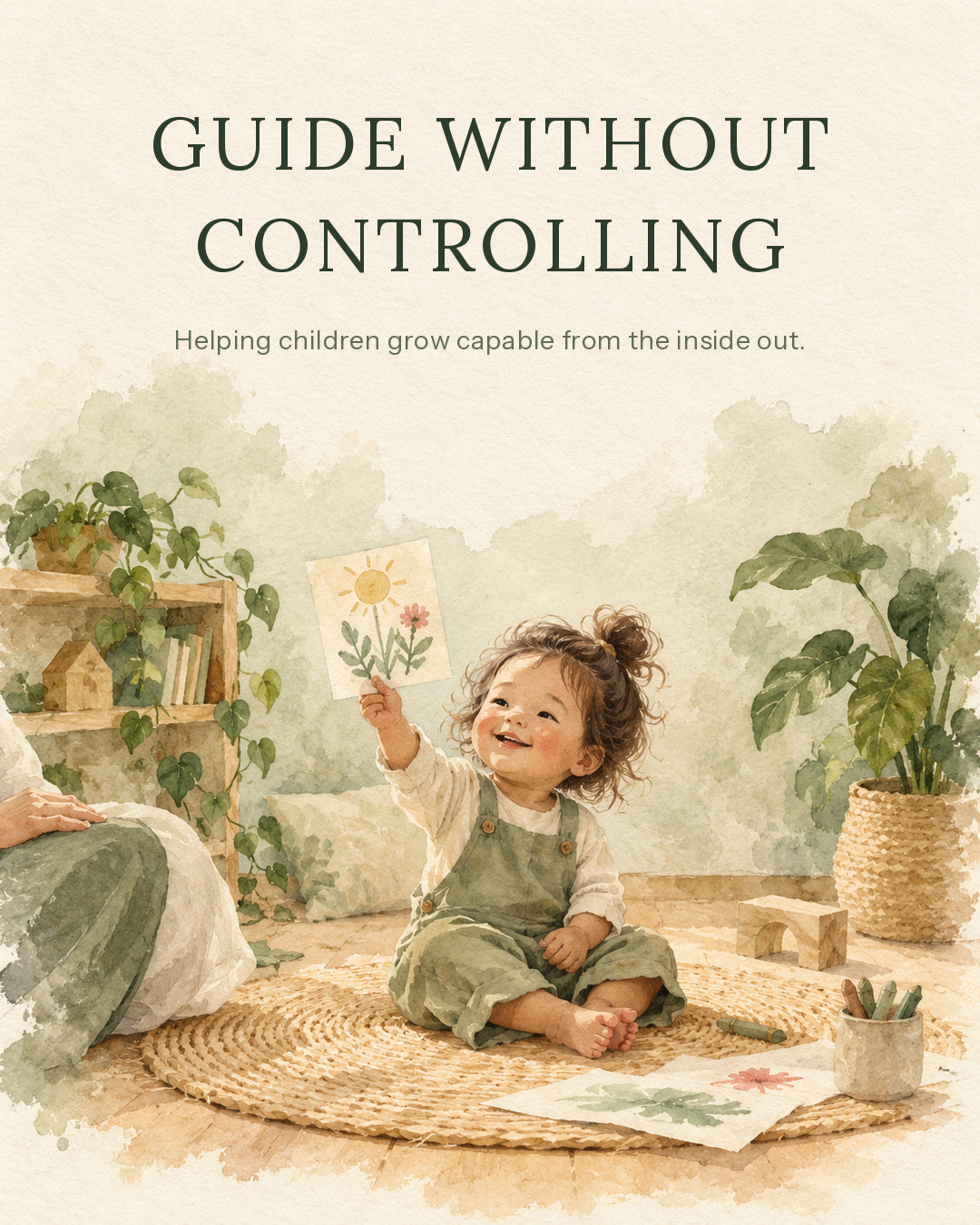
Guide Without Controlling
Praise and punishment are not opposites. Both leave a child looking outward for the verdict. On helping children grow capable from the inside out.
She finishes the drawing and looks up before you have even seen it.
Her eyes find yours. She is waiting.
It is such a small moment. Most of us would not even notice it. We glance over, we smile, and we say what comes naturally.
“That’s beautiful.”
“Good job!”
“You’re such a good artist.”
And she beams, and goes back to her paper, and it feels like we gave her something good.
But I have been sitting with that moment, and the question underneath it.
Why did she look up before she had looked at it herself?
Praise and punishment are not opposites
We tend to think of praise and punishment as two ends of a line. One is kind and one is harsh. One builds a child up and one tears a child down.
But they have more in common than we like to admit.
Punishment says: I decide when you have gone wrong.
Praise says: I decide when you have gone right.
Both place the verdict outside the child. Both teach her that the meaning of her work lives in an adult’s reaction.
This is not about withholding warmth. Children need our delight, our attention, and our presence. The question is not whether we respond to them, but whether our response leaves room for theirs.
What may be happening underneath
A young child is still building an internal sense of her own work.
This is mine.
I made it.
I know whether it is finished.
That sense does not arrive all at once. It grows slowly, in the quiet gaps between doing something and being told what it means.
When a reaction arrives at every moment, the gaps close.
The child learns to finish, look up, and wait. Over time, the waiting can become the point. The work becomes something to hand over for approval rather than something to explore, return to, and own.
One thing to try: describe instead of evaluate
The next time she looks up, try describing what you see instead of judging it.
“You used a lot of blue in this corner.”
“You drew the sun all the way at the top.”
“You worked on that for a long time.”
These words still say: I see you. I am interested. But they hand the judgment back to her. She gets to decide what she thinks of it.
“That’s beautiful” hands her something to collect.
A description hands her something to consider.
This is one reason you will rarely hear “good job” in many Montessori classrooms. It is not coldness. It is respect for the child’s own sense of her work.
You might also ask a question, and then really wait for the answer.
“Tell me about this part.”
“How did you decide where to put the flower?”
Sometimes she will tell you a whole story. Sometimes she will shrug and go back to work. Both are fine. The point is not to get the right response from her. The point is to leave the space open.
It will feel strange at first
If you have been saying “good job” for years, this can feel awkward. That is normal. Habits of language run deep, and most of us were raised on praise ourselves.
You do not have to get it right every time. You will still say “that’s beautiful” sometimes, because sometimes it simply is. This is not a new rule to follow perfectly. It is an invitation to notice.
Something to notice
Some of the most valuable work a child does is work you never see.
The drawing she finishes and quietly puts away. The puzzle she does three times, just for herself. The leaves she arranges on paper, alone, with no one watching.
That work belongs entirely to her. No one praised it. No one corrected it. And it may be some of the most important work of all, because it is where she learns to trust her own sense of what is good.
When we guide without controlling, we protect that space.
What have you noticed in your own home or classroom? I would love to hear.
If you would like support thinking through moments like this with your own child, you can book a free discovery call.
Leave a comment