
How I Set Up a Summer Bridge Plan Without Making Summer Feel Like School
A summer bridge plan does not have to feel like school at home. Here is how I created a gentle Montessori-inspired rhythm using observation, hands-on materials, child-friendly checklists, and a prepared environment to help children grow with confidence.
Every summer, I tell myself the same thing.
We are going to rest. We are going to slow down. We are not going to overpack the days.
And then, somewhere between the end-of-year backpacks, the report cards, the random papers coming home, and the realization that the next school year is not actually that far away, I start thinking, “Okay, but maybe we should practice a little.”
Not in a stressful way. Not in a “sit down for three hours and finish this packet” kind of way. But in a gentle, intentional way.
Because the truth is, summer is a beautiful time for children to breathe, play, explore, and be free. But it can also be a really good time to slowly strengthen the skills that felt shaky during the school year.
This year, I decided to create a summer bridge plan for my children. I wanted something that would help them feel more confident going into the next school year, but I also wanted it to feel doable for us as a family.
I knew that if the plan was too complicated, I would not keep up with it. And if it felt too much like school, my children would resist it. So I tried to create something that felt like a rhythm, not a rigid schedule.
Something clear.
Something visual.
Something hands-on.
Something that still felt like summer.
I started with the report cards, but I tried not to panic
Let’s be honest, reading report cards as a parent can bring up a lot of feelings.
You see the positives and feel proud. Then you see one comment about comprehension, handwriting, math facts, focus, or behavior, and suddenly your mind starts racing.
Did I miss something?
Should we have practiced more?
Are they behind?
What do I need to do now?
I had to remind myself to slow down.
A report card is not a final judgment on a child. It is information. It is a snapshot. It can help us see what is going well and what still needs more time.
As a Montessori educator, I always come back to observation. Before we correct, we observe. Before we rush into fixing, we try to understand.
So I looked at the report cards as a map. I noticed which skills were strong, which skills were still developing, and which comments kept showing up. That helped me decide what to focus on for the summer.
For one child, reading aloud was a strength, but comprehension needed more support. So I knew we needed to practice summarizing, staying on topic, answering questions clearly, and going back to the text for evidence.
For another child, phonics, sight words, vowel teams, handwriting, and complete sentences needed more attention. So I knew we needed short, successful practice with magnetic letters, word cards, easy readers, and simple writing prompts.
For math, I looked at the skills that would help them feel ready for the next grade. Things like place value, numbers past 100, multiplication, division, fractions, time, money, measurement, and word problems.
This helped me avoid random practice. I did not want to print a pile of worksheets just to feel like we were “doing something.” I wanted the work to actually connect to what they needed.
I chose a few priorities, because we cannot do everything
One thing I have learned the hard way is that when I try to work on everything, we end up doing nothing well.
Children need repetition. They need time. They need small wins.
So instead of trying to cover every subject and every standard, I chose a few focus areas.
For reading and language, I focused on daily reading, comprehension, spelling patterns, handwriting, complete sentences, and writing with more detail.
For math, I focused on daily IXL practice, hands-on math materials, math facts, place value, fractions, time, money, and word problems.
That already sounds like a lot, but the difference is that we are not doing all of it every day. I rotate the skills through the week. Some days are for reading and story work. Some days are for labels and handwriting. Some days are for word problems. Some days are for recipes, fractions, and real-life math.
From a child development perspective, this makes sense. Children do not master a skill just because we explained it once. They need to meet the same skill again and again in different ways.
Sometimes they need to build it.
Sometimes they need to say it out loud.
Sometimes they need to move with it.
Sometimes they need to write it.
Sometimes they need to come back to it next week when their brain is more ready.
That is why I wanted the plan to be hands-on and repetitive, but not boring.
I created a rhythm instead of a strict schedule
I know some families do really well with a detailed schedule. For us, I needed something clear enough to guide the day, but flexible enough to survive real life.
So I created a daily work cycle rhythm.
It starts with setting up the workspace. Then we begin with duaa. After that, the children read and log their books. They do 20 minutes of IXL math, take a short break, complete the daily lesson, take another break, finish one math worksheet and one language arts worksheet, then move into choice work. Arabic and Qur’an are part of the daily rhythm too.
The breaks are not an afterthought. They are part of the plan.
Children need movement. They need pauses. They need a chance to reset. And honestly, so do we.
This rhythm also helps with independence. When children know what comes next, they need fewer reminders. The checklist becomes the guide instead of me repeating myself all morning.
And that is very Montessori to me.
Independence does not happen because we tell children, “Be independent.” It happens when we prepare the environment and the routine in a way that makes independence possible.
I made everything visual
I made daily checklists for each child with the steps of the work cycle.
This was not just to make things cute, although I do love a beautiful checklist. It was because children need to see what is expected.
A visual checklist helps them know:
What do I do first?
What comes next?
How much is left?
When am I done?
It also helps reduce the back-and-forth. Instead of me constantly saying, “Did you do your reading? Did you log your book? Did you finish IXL?” they can look at the checklist and take ownership.
At the end of the checklist, I added a simple reflection section:
What did I do well today?
What can I improve tomorrow?
I really love this part.
I do not want them to think learning is only about getting everything right. I want them to notice their effort, their habits, and their growth.
Maybe they rushed through handwriting today. Maybe math felt easier than last week. Maybe they remembered to read without being reminded. Maybe they were frustrated but still tried.
That matters.
Reflection helps children build self-awareness. It teaches them that mistakes are not the end of the story. They are information.
I prepared the environment so I would not have to keep searching for everything
Another honest moment: if I have to search for the pencil, the worksheet, the reading log, the math blocks, and the sight word cards every morning, the plan is not going to last.
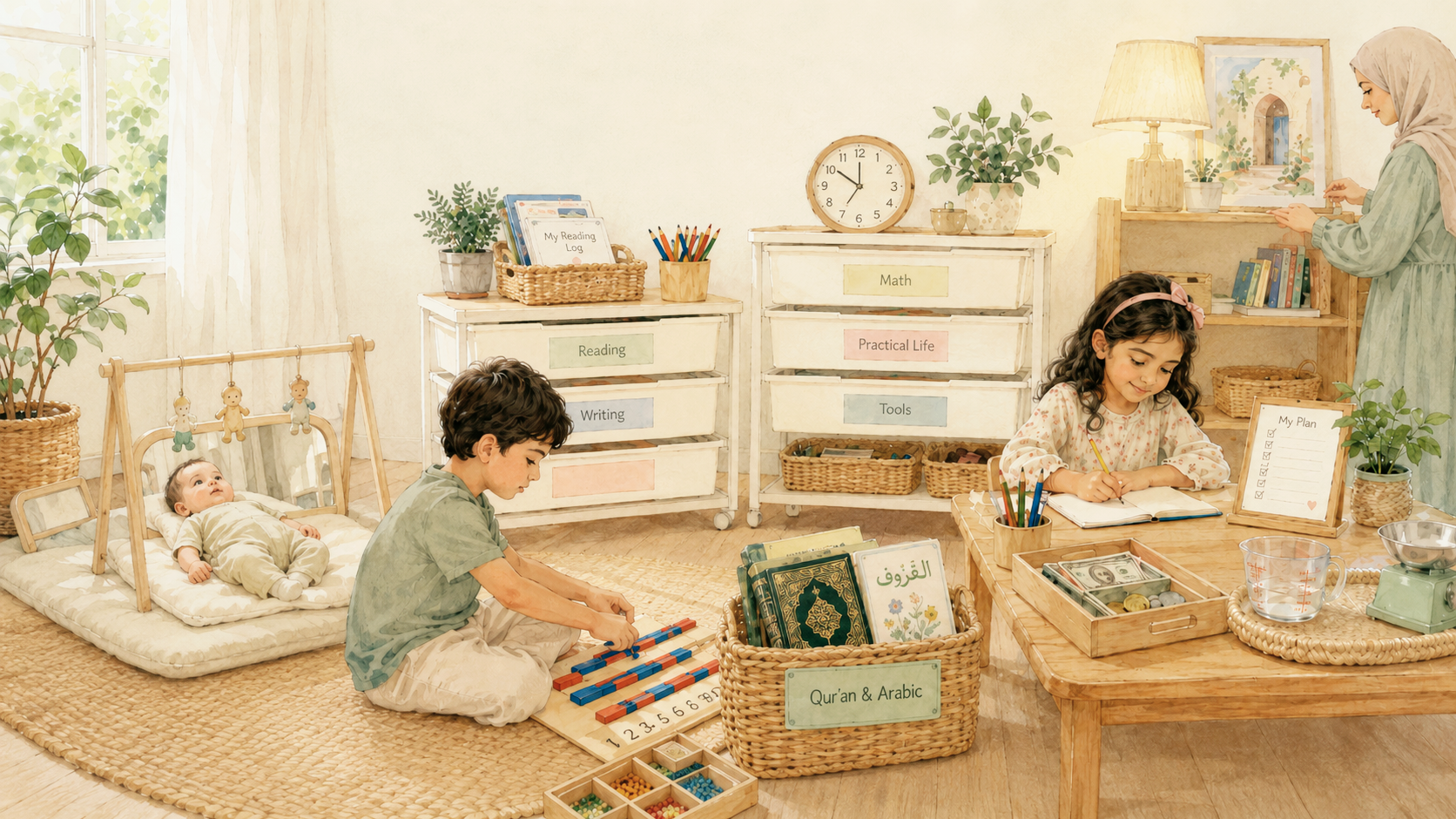
So I set up drawer carts.
Each child has their own cart. Their materials are separated, labeled, and easy to reach. One cart holds the materials one child needs, and the other cart holds the materials for the other child.
The drawers include things like reading, spelling, handwriting, mathematics, paper, notebooks, supplies, magnetic letters, reading rods, chalkboard and whiteboard, and daily to-do work.
I also made a separate basket for Qur’an and Arabic. I wanted those materials to have a clear and respectful place in our rhythm, not be mixed in with random school supplies.
This is where the Montessori idea of the prepared environment becomes so practical.
A prepared environment is not about making your home look like a classroom. It is about removing unnecessary obstacles.
If children can find what they need, they are more likely to begin.
If every material has a home, they are more likely to clean up.
If the space feels calm, they are more likely to focus.
The environment quietly teaches.
I used labels because children need order too
I created watercolor-style labels for the drawers. They are soft, simple, and easy to read.
The labels are not just decoration. They help the children know where things belong.
Order is very important for children. When the space is confusing, children often become scattered. When the space is clear, they can move with more confidence.
And I will be honest, the labels help me too. I am much more likely to keep up with a system when it looks beautiful and makes sense.
There is something calming about knowing where the magnetic letters go, where the paper goes, where the notebooks go, and where the math materials live.
It makes the whole plan feel less overwhelming.
I balanced worksheets with hands-on materials
Worksheets have a place, but I did not want worksheets to become the whole plan.
Children need to touch things. They need to build, sort, count, match, move, label, and create.
So I included materials like magnetic letters, reading rods, sight word cards, vowel team cards, whiteboards, chalkboards, base-ten blocks, the stamp game, multiplication and division boards, fraction materials, clocks, play money, measuring tape, dice, cards, and recipe cards.
For example, if we are practicing place value, a child can build the number first, then say the number, then write it, then try a paper activity.
If we are practicing spelling, the child can build the word with magnetic letters before writing it by hand.
This follows a core Montessori principle: we move from concrete to abstract.
Before a child is expected to do everything on paper, they need real experiences with the concept. The hands prepare the mind.
I chose books they actually want to read
I wanted reading to feel inviting, not like a punishment.
So I leaned into their interests. Graphic novels, funny books, nonfiction, fact books, superhero books, recipes, and comic-style books all have a place.
Sometimes we get so focused on the level of the book that we forget the child in front of us. Interest matters. A child who is excited to read is going to read more. And the more they read, the stronger they become.
The reading log is simple. They record the title, author, pages read, and sometimes how they felt about the book.
It is not meant to be another assignment. It is meant to help them see themselves as readers.
I included real life because learning is not only at the table
Some of the best learning happens in normal family life.
Cooking teaches reading, sequencing, fractions, measurement, and responsibility.
Playing store teaches money, counting, adding, subtracting, and decision-making.
Setting the table teaches order and care.
Organizing supplies teaches responsibility and executive functioning.
Helping with cleaning or laundry builds independence and practical life skills.
This is one of the reasons I love Montessori. Practical life is not treated as less important than academics. It is foundational.
Children need to feel capable in real life, not just on paper.
I left space for choice
Each day includes “work of your choosing.”
This part is important because children need some ownership.
Choice does not mean there is no structure. It means the adult prepares meaningful options, and the child gets to choose within that prepared space.
They might choose a book, a puzzle, a math material, a writing prompt, a drawing activity, a practical life task, or a game.
Choice helps children feel respected. It also gives us information. What do they keep choosing? What do they avoid? What are they drawn to when no one is forcing them?
That is observation too.
I made the plan realistic for me
This might be the most important part.
The plan had to work for me as the parent too.
I did not want something that required me to sit beside them every second. I wanted to prepare the space, explain the rhythm, check in, help when needed, and then let them practice.
My role is to prepare, observe, guide, and adjust.
Some days will go smoothly. Some days will not. Some days we will finish everything. Some days we will only do reading and IXL, and that will be okay.
A plan that allows real life is a plan we can return to.
If you want to create your own summer bridge plan
Start simple.
Look at your child’s report card or work from the school year. Notice what needs more practice, but also notice what your child enjoys and where they feel confident.
Choose a few focus skills. Not everything.
Create a simple daily rhythm. It could be reading, math practice, one hands-on lesson, one short written task, choice work, and reflection.
Prepare a small space with the materials your child needs. You do not need a perfect setup. Baskets, folders, drawers, or trays can all work.
Use hands-on materials whenever possible. Before giving a worksheet, ask, “Can my child build this, sort this, move with this, or use it in real life?”
Track progress gently. A checklist, reading log, or weekly reflection is enough.
And most importantly, protect the feeling of summer.
Children need practice, but they also need rest. They need sunshine, play, boredom, imagination, family time, and slow mornings.
Final thoughts
This summer bridge plan is not about turning summer into school.
It is about creating a gentle bridge.
A bridge between what the child practiced this year and what they are growing into next.
A bridge built with books, baskets, labels, checklists, hands-on materials, practical life, and a lot of grace.
I know it will not be perfect. I am sure there will be days when someone complains, someone loses a pencil, someone rushes through handwriting, or someone suddenly needs a snack right in the middle of math.
That is real life.
But I also know that a little rhythm can go a long way.
A prepared space can make the morning feel calmer.
A checklist can help a child feel more independent.
A beautiful label can invite care.
A hands-on material can make a concept finally click.
A few minutes of reflection can help a child notice their own growth.
And sometimes that is enough.
One peaceful morning at a time.
One drawer at a time.
One book, one lesson, one small step at a time.
Leave a comment