
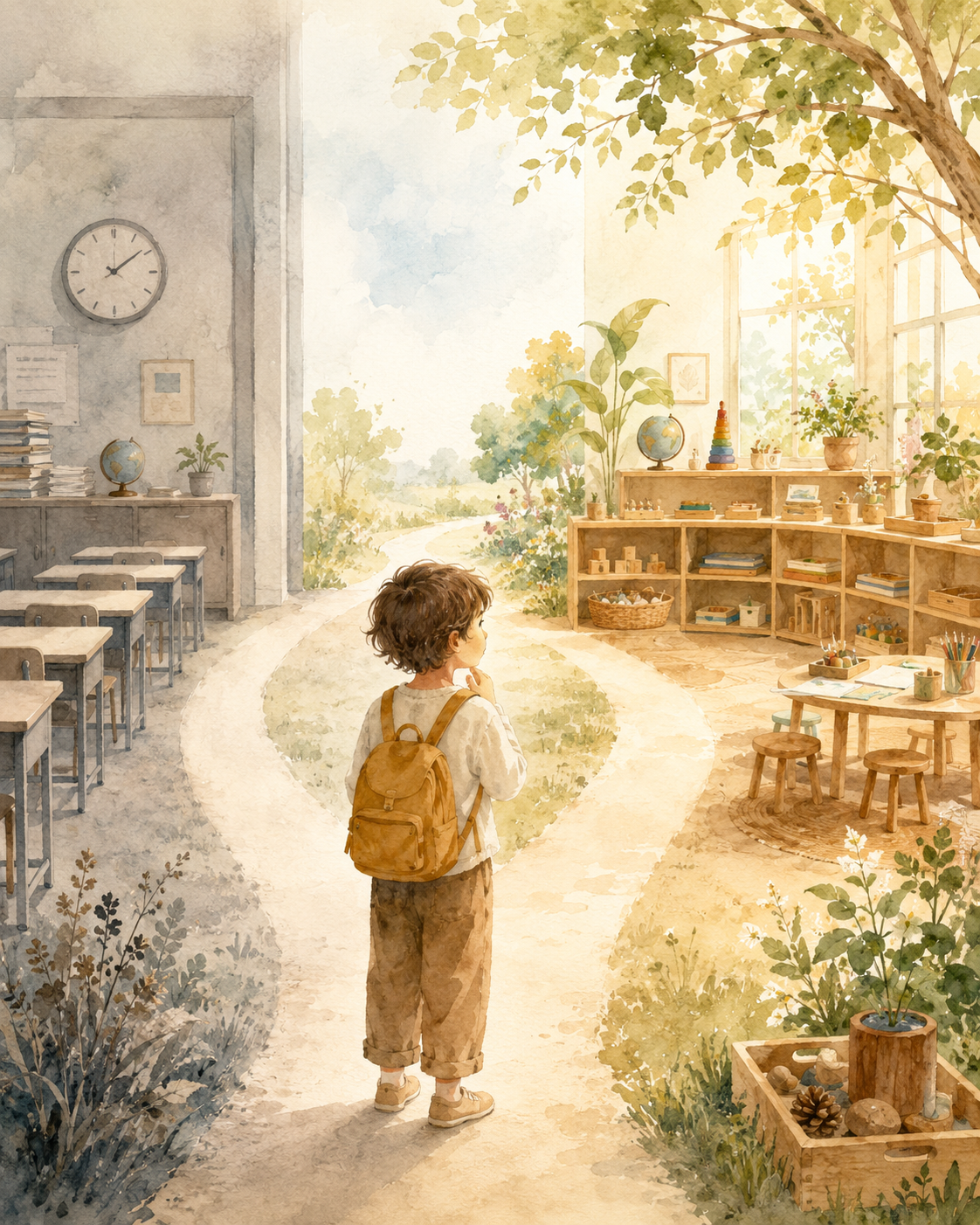
Protecting the Child’s Wonder: Reflections on Weapons of Mass Instruction
Inspired by John Taylor Gatto’s Weapons of Mass Instruction, this reflection explores what education is truly meant to awaken in a child — and how Montessori principles can help protect curiosity, independence, and wonder.
I recently spent time reflecting on Weapons of Mass Instruction by John Taylor Gatto, and it is not the kind of book you simply read and place back on the shelf.
It lingers.
It asks questions that feel uncomfortable, especially for those of us who care deeply about children, education, and the kind of world we are preparing them for. Gatto’s voice is strong, and at times, provocative. I do not think every reader will agree with every conclusion he makes, and I do not believe every school or educator fits neatly into one criticism.
But I do believe the questions he raises are worth sitting with.
Because underneath the sharpness of his critique is something many parents and educators quietly wonder:
Are we helping children become whole, capable, curious human beings?
Or are we training them to wait, comply, perform, and slowly disconnect from their own inner voice?
That question stayed with me.
As a Montessori educator, a mother, and someone who believes deeply in the dignity of the child, I kept coming back to one central reflection:
What is education really for?
Not only what a curriculum says it is for.
Not only what a test tries to measure.
Not only what a system rewards.
But truly — what is education meant to awaken in a child?
Children come into the world with such a natural desire to learn. They observe, question, imitate, repeat, build, sort, move, wonder, and make meaning long before anyone formally teaches them. Their curiosity is not something we have to manufacture. It is already there.
The work of education, then, is not to force learning into the child.
It is to protect the conditions where learning can remain alive.
This is one of the reasons Montessori continues to feel so meaningful to me. Montessori is not simply a method, a shelf of beautiful wooden materials, or a peaceful-looking classroom. At its heart, Montessori is a way of seeing the child.
It sees the child as capable.
It respects the child’s pace.
It honors concentration.
It allows meaningful choice.
It gives freedom within thoughtful limits.
It prepares an environment where independence can slowly bloom.
And perhaps most importantly, it trusts that children are not empty vessels waiting to be filled. They are active builders of themselves.
When I think about Gatto’s reflections on traditional schooling, I think about how often children are interrupted just as they begin to go deep. The bell rings. The subject changes. The adult redirects. The schedule moves on. The child learns to stop before they are finished, to shift before they are ready, and to look outward for permission rather than inward for purpose.
Over time, this can shape the way a child relates to learning.
Instead of asking, “What am I curious about?”
They may begin asking, “What answer does the adult want?”
Instead of feeling the quiet satisfaction of mastery, they may begin chasing approval.
Instead of seeing mistakes as part of discovery, they may begin seeing them as failure.
And this is where my heart pauses.
Because childhood is not preparation for life someday. Childhood is life already unfolding.
Children deserve education that respects that.
They deserve adults who are not only concerned with what they know, but with who they are becoming. They deserve spaces where their hands can work, their minds can wonder, their bodies can move, and their voices can be heard. They deserve to experience learning as something meaningful, not something simply done to them.
This does not mean children do not need structure. They absolutely do.
Children need rhythm.
They need boundaries.
They need guidance.
They need adults who are prepared, observant, and intentional.
Freedom without structure can feel chaotic. But structure without freedom can feel like confinement.
The balance matters.
A prepared environment says to the child, “You are capable.”
A respectful routine says, “You are safe.”
Meaningful work says, “You have something valuable to contribute.”
Freedom within limits says, “Your choices matter, and so does the community around you.”
This is the kind of education I keep returning to.
Not an education built only around speed, output, comparison, and performance.
But an education that nurtures independence, concentration, compassion, resilience, creativity, and joy.
One of the most important reflections this book stirred in me is that parents, educators, and school leaders do not have to accept every system exactly as it is. We are allowed to question. We are allowed to observe. We are allowed to ask whether a practice truly serves the child or simply serves the structure around the child.
And sometimes, the most powerful thing we can do is return to the child in front of us.
Watch them.
Listen to them.
Notice when their eyes light up.
Notice when their shoulders soften.
Notice when they become deeply engaged, not because someone demanded it, but because something within them has awakened.
That is where real education begins.
For me, Weapons of Mass Instruction was not only a critique of schooling. It was an invitation to reflect more honestly on the environments we create for children. It reminded me that education should never strip children of wonder in the name of achievement. It should never ask them to trade curiosity for compliance. It should never make them feel small so a system can feel efficient.
Our work, whether at home, in a classroom, or within a school community, is to protect the child’s natural desire to learn.
To guide without overpowering.
To prepare without pressuring.
To offer beauty, order, language, movement, and meaningful work.
To trust that children are not products to be shaped, but human beings slowly revealing themselves.
And maybe that is the reflection I am carrying most deeply:
The goal of education is not to mass-produce children who can simply follow instructions.
It is to nurture human beings who can think, feel, create, contribute, and remain connected to themselves.
That kind of education is slower.
It is more intentional.
It asks more from us as adults.
But it is also more human.
And our children deserve nothing less.
Leave a comment