
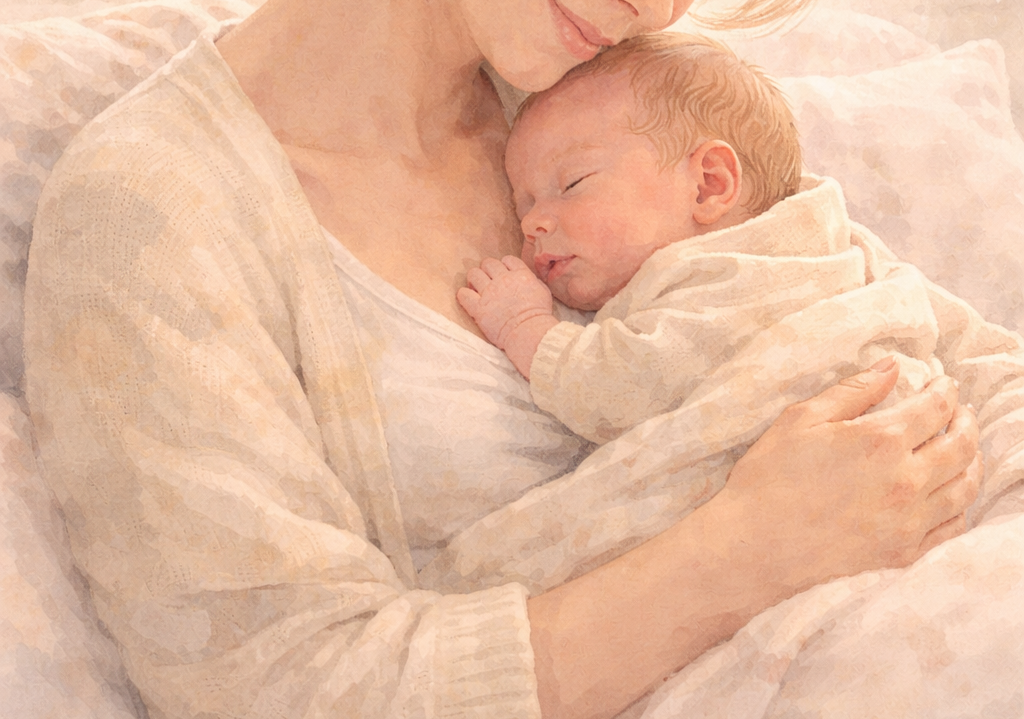
The First Week of Life: What I Wish I Could Gently Whisper to Every New Mother
The first week with a newborn can feel tender, blurry, and intense. This reflection offers gentle reassurance on why babies feed so often, wake so much, crave constant closeness, and what is happening in a mother’s body and heart during those early postpartum days
The first week with a new baby is unlike anything else.
It is beautiful, yes. But it is also disorienting. Time loses its shape. Day and night stop feeling separate. You may find yourself sitting in the same corner of the couch, feeding, holding, rocking, wondering how an entire afternoon disappeared. You may look at your baby and feel overwhelmed with love, only to feel, a few minutes later, overwhelmed by the sheer intensity of it all.
And somewhere in between, one question keeps returning:
Is this normal?
Is it normal for my baby to want to feed this often?
Is it normal for nights to feel harder?
Is it normal that they only settle in my arms?
Is it normal that I feel so emotional, so tired, so tender?
So often, the answer is yes.
That is what I wish more mothers were told in the beginning.
Not just what to do, but why this phase feels the way it does.
Because when you understand what is happening, it becomes a little easier to soften into it.
Your baby has just arrived from a world where everything was constant. For months, they were held all the time. They lived in warmth, darkness, rhythm, and closeness. They heard your voice, your heartbeat, the gentle movement of your body. Then suddenly, they are here. The air feels different. Hunger feels different. Sleep feels different. Light, sound, touch, and space all feel different.
So when a newborn wants to be close all the time, that is not a sign that something is wrong.
It is one of the most natural things in the world.
Your baby is looking for what feels familiar. Your warmth. Your chest. Your smell. Your voice. Your arms. Being near you helps them settle into life outside the womb. It helps them feel safe. It helps them regulate.
And honestly, when I remember that, I can hold those early days with more tenderness.
Not because the constant holding becomes easy, but because it starts to make sense.
The same is true of feeding.
One of the biggest surprises in the first week is often just how often a baby wants to nurse. Especially at night. Especially when you are already exhausted. It can feel endless. When you think the feed is over, they want to come back again.
And that can be so hard.
But there is also a reason for it.
In the beginning, babies feed often because their stomachs are tiny and because frequent nursing helps bring milk in and build supply. Night nursing can feel especially intense because the hormones that support milk production are naturally higher overnight. So those long, repetitive nighttime feeds are not meaningless. Your baby is not simply waking to make life harder. In many ways, your baby and your body are working together, especially in those first days, to establish what breastfeeding will become.
That does not make the nights less tiring.
But it can make them feel less confused.
And then there is the sleep, or what we hope will be sleep.
So many mothers enter the first week hoping for rest whenever the baby rests, only to find that newborn sleep comes in short, broken stretches. Babies wake often. They do not yet know day from night. They stir, feed, doze, wake again. And for a tired mother, it can feel like there is no rhythm at all.
But in the first week, that scattered pattern is often exactly what we would expect from a brand-new baby.
Their bodies are still learning how to regulate outside the womb. Their feeding is still being established. Their sense of time is still immature. Even their waking serves a purpose. Frequent waking helps them feed and stay connected, and keeps them from staying too long in one state when their systems are still so new.
In other words, your baby is not doing life wrong.
Your baby is one week old.
I think that truth matters so much because so many mothers quietly interpret these early patterns as a problem to solve. But sometimes, the first week does not need solving as much as it needs understanding.
And while all of this is happening in your baby, something profound is happening in you, too.
Your body is healing from birth. Your womb is contracting. Your bleeding is part of recovery. Your milk may be changing and increasing in volume. Your hormones are shifting quickly. Your breasts may feel fuller. Your body may ache. Your emotions may rise and fall without warning. You may cry more easily than expected. You may feel deeply grateful and strangely fragile at the same time.
None of that means you are weak.
It means you have just crossed through something enormous.
The first week is not only the baby’s transition. It is yours too.
And maybe that is why I wish mothers were met with more gentleness in this season. Because so much of what is happening can feel alarming when unfamiliar, but deeply human when understood.
Your baby wants to be near you because closeness helps them feel safe.
Your baby wakes often because newborn rhythms are still forming.
Your baby feeds often because their body is growing and, if you are nursing, because your milk supply is still being established.
Your emotions are close to the surface because postpartum is physical, hormonal, emotional, and spiritual all at once.
Nothing about this week is small.
Even if it looks repetitive from the outside, something foundational is being built.
Your baby is learning what it means to be comforted.
What it means to be fed.
What it means to cry and be answered.
What it means to rest against another human body and feel safe enough to soften.
And you are learning too.
You are learning this baby’s sounds.
This baby’s rhythms.
This baby’s cues.
You are learning how to mother this child, in this season, in this version of yourself.
That is why I have come to believe that the first week is not really about getting into a routine or doing everything “right.”
It is about a relationship.
It is about helping a baby land gently in the world.
It is about a mother being allowed to heal while also being held, supported, and reminded that this intensity has meaning.
So if your first week feels like a blur of feeding, waking, holding, crying, healing, and starting over again, I hope you know this:
That does not mean you are behind.
That does not mean your baby is difficult.
That does not mean you are doing something wrong.
It may simply mean you are in the first week.
And the first week is tender for a reason.
It is not a phase of perfection.
It is a phase of becoming.
Your baby is becoming someone in the world.
And you are becoming, too.
Leave a comment