
What Can You Do With Your Baby in the First Couple of Weeks?
In the first couple of weeks, your baby does not need a packed wake window or lots of stimulation. This gentle guide explores what newborns truly need during waking hours through a developmental and Montessori lens, and how simple moments of connection can beautifully support early growth.
The first couple of weeks with a new baby can feel both beautifully simple and surprisingly consuming.
So much of the day is spent feeding, changing, holding, burping, settling, and starting again. And in the middle of that rhythm, many mothers quietly wonder:
Should I be doing more when my baby is awake?
Am I supposed to be entertaining them?
What actually supports development at this stage?
The short answer is this:
In the first couple of weeks, your baby does not need activities in the way older babies do. They do not need stimulation, toys, or a packed wake window. What they need most is a relationship, regulation, gentle sensory experience, and time to adapt to the world outside the womb.
And from a Montessori lens, that is not “nothing.” That is the beginning of everything.
The Montessori lens in the newborn weeks
Montessori begins with deep respect for the child as a whole person from the very beginning.
That means even in the earliest days, we are not trying to rush development or “teach” a baby through performance. We are observing. We are responding. We are preparing a peaceful environment. We are trusting that development is already unfolding, and our role is to support it gently.
In the first weeks of life, your baby is in a profound period of adaptation. They are adjusting to light, sound, touch, air, hunger, closeness, and movement outside the womb. So the most developmentally supportive thing you can offer is not more stimulation. It is a calm, responsive beginning.
What newborn wake windows are really for
In the first couple of weeks, wake windows are usually very short. Sometimes they may only last long enough for a diaper change, a feeding, a bit of eye contact, and a brief cuddle before your baby is ready to rest again.
That is normal.
At this stage, waking hours are less about “doing” and more about connecting, feeding, adjusting, gently taking in the environment, and building a sense of safety.
So if your day feels repetitive, that does not mean it is lacking. Repetition is the work of early life.
What you can do with your baby during waking hours
Let them look at your face
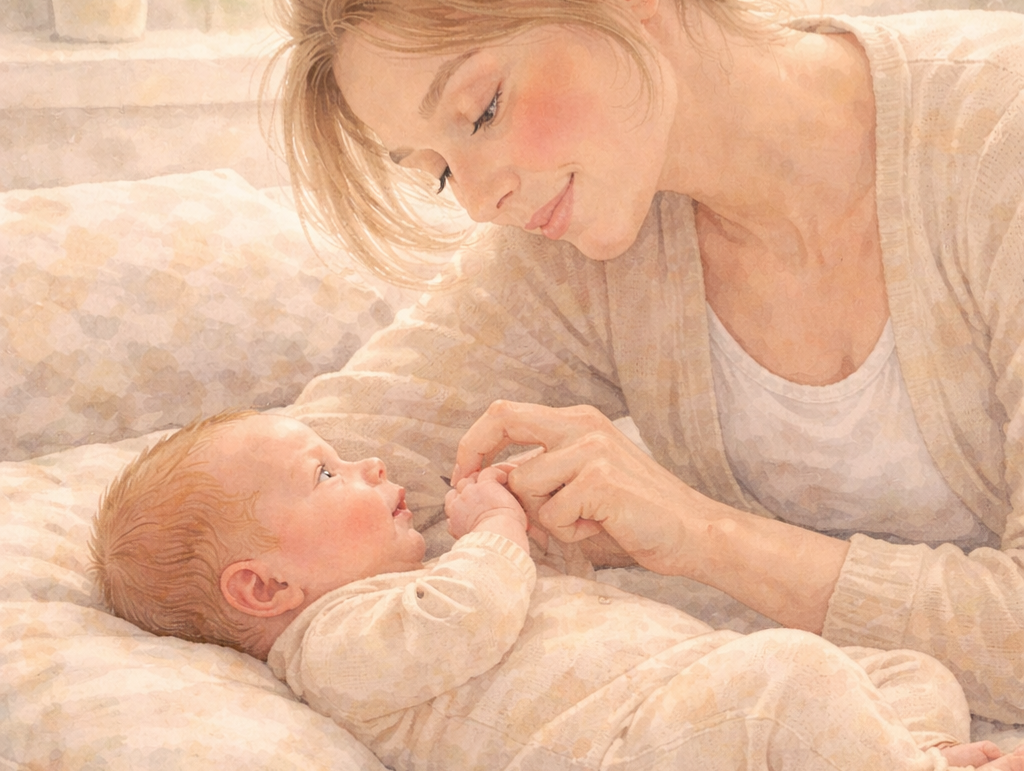
One of the most meaningful things your baby can do in the early weeks is look at you.
Newborns are especially drawn to human faces, particularly at close range. During feeds, diaper changes, or moments in your arms, pause and let your baby study your face. Speak softly. Smile gently. Let them hear the rhythm of your voice.
From a developmental standpoint, this supports early social connection and visual attention.
From a Montessori lens, this is a reminder that the human relationship comes before the object. You are your baby’s first environment.
Talk to them during care routines
Narrate simple things as you move through the day.
You do not need to fill every silence. Just let your voice be present.
You might say: “Now I’m changing your diaper.”
“I’m picking you up.”
“You were hungry, and now your body is feeling full.”
“I’m opening the curtains so you can see the light.”
This supports language development through exposure to real, meaningful speech. It also helps your baby begin to experience care as something predictable and respectful.
Montessori reminds us that care moments are not interruptions to development. They are developing.
Offer skin-to-skin time
Skin-to-skin is one of the most nourishing things you can do in the newborn days.
It supports regulation, bonding, warmth, and calm. It gives your baby a sense of familiarity in a world that is still very new. Your heartbeat, your breath, your scent, and your warmth all help your baby settle.
From a developmental perspective, this supports nervous system regulation.
From a Montessori perspective, this is part of honoring the baby’s deep need for security and connection before expecting anything else from them.
Give them time to observe the room
When your baby is calm and alert, let them quietly look around.
You do not need to dangle toys or overstimulate them. Simply holding them upright or laying them down in a peaceful space where they can observe light, shadow, a simple wall, a window, or a familiar corner of the room is enough.
Montessori environments begin with simplicity. In the newborn stage, less is often more. A calm visual field helps your baby take in the world slowly.
Use slow, respectful movement
Pick your baby up slowly. Lower them gently. Pause before transitions.
This may seem small, but it matters. Fast, abrupt movements can feel jarring to a newborn whose nervous system is still learning to regulate. Slow, intentional handling helps them feel secure.
Montessori emphasizes respectful care, and that begins from birth. Even a very young baby benefits from being handled as though their body deserves gentleness and communication.
Provide supervised floor time for a few minutes
In the first couple of weeks, this does not need to mean tummy time in a pressured sense. It can simply mean a few minutes on a firm, safe surface while your baby stretches, moves, and experiences their body with freedom.
You can place your baby on their back on a simple mat or blanket while they are calm and awake. This gives them the chance to move naturally rather than always being contained in arms, swings, or seats.
Montessori values freedom of movement, and that begins very early. Even tiny movements matter. Stretching, turning the head, opening the hands, and kicking are all part of your baby discovering their body.
Offer brief tummy time on your chest
For a very young newborn, one of the gentlest ways to begin tummy time is on your chest.
When your baby is resting on you, they may naturally try to lift or turn their head slightly. This supports early neck strength in a way that feels comforting and connected.
Keep it gentle and brief. In the first weeks, the goal is not performance. The goal is experience.
Go outside, if possible
A little fresh air, natural light, and a change of scenery can be restorative for both mother and baby.
You do not need an outing. Even sitting by an open window, stepping onto a porch, or taking a short walk with your baby held close can offer gentle sensory nourishment.
From a Montessori lens, nature is part of the child’s environment from the very beginning. A breeze, birdsong, filtered light, and leaves moving overhead are all beautiful first impressions of the world.
Protect calm
This may be the most overlooked “activity” of all.
Newborns do not need constant input. They need space to rest, process, and remain regulated. In the first weeks, too much noise, bright light, frequent passing around, or back-to-back stimulation can quickly become overwhelming.
A Montessori approach reminds us to prepare the environment, and for a newborn, that often means: softer light, less clutter, fewer loud interruptions, slower rhythms, and more predictability.
Calm is not boring for a newborn. Calm is supportive.
What not to worry about in the beginning
You do not need flashcards.
You do not need baby classes.
You do not need to fill every waking window with a special activity.
You do not need to get ahead.
Your baby is not waiting for enrichment in the way social media sometimes suggests.
In the first couple of weeks, development is supported by the simplest things: being held, being fed, hearing your voice, seeing your face, moving freely at times, resting in a peaceful environment, and experiencing gentle, predictable care.
That is real developmental support.
A gentle newborn rhythm through a Montessori lens
If it helps, you can think of the early weeks like this:
Your baby wakes.
They are changed, fed, held, spoken to, and perhaps allowed a few quiet moments to observe or stretch.
Then they rest again.
And inside that simple rhythm, so much is happening.
They are learning safety.
They are learning trust.
They are learning the feel of their body.
They are learning the sound of your voice.
They are learning that the world meets them gently.
That is not small work. That is foundational work.
For the mother who feels like she should be doing more
If you are in the first weeks and wondering whether you are doing enough, let this reassure you:
If you are feeding your baby, holding your baby, changing them with care, speaking gently, offering calm, and responding to their needs, then you are already doing deeply meaningful developmental work.
The Montessori way, in the beginning, is not about doing more.
It is about seeing more.
Seeing your newborn as capable of taking in the world.
Seeing the environment as influential.
Seeing care as a relationship.
Seeing simple moments as worthy and full.
And perhaps most of all, trusting that these quiet beginnings matter.
Leave a comment